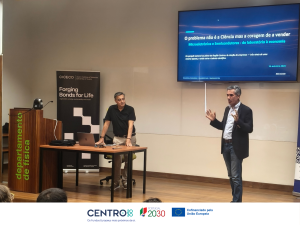
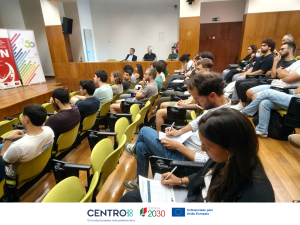
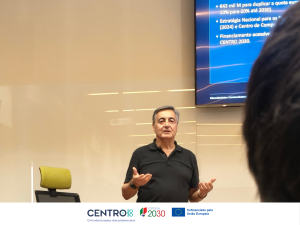
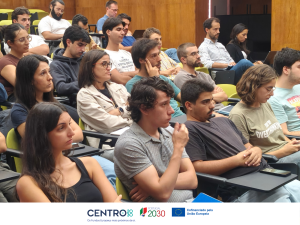
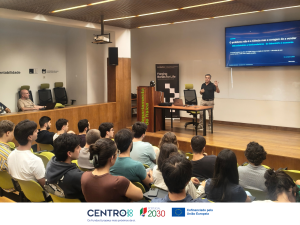
More than 35 participants attended the first dissemination session of the Start-up Microelectronics Centro project, held as part of the Semiconductor and Technologies Lecture Series organised by the Department of Physics at the University of Aveiro. The session highlighted the importance of transforming scientific knowledge into innovation, economic value and new businesses.
On 14 October 2026, Inova-Ria hosted the first dissemination session of the Start-up Microelectronics Centro project, as part of the Semiconductor and Technologies Lecture Series, organised by the Department of Physics at the University of Aveiro (DFis-UA).
The event took place from 4:00 pm to 5:30 pm at the Professor Doutor Manuel Fernandes Thomaz Auditorium, at the University of Aveiro, and brought together more than 35 participants, including students and individuals interested in entrepreneurial opportunities in the microelectronics and semiconductor sectors.
Under the theme “The problem is not science, but the courage to sell it – Microelectronics and Semiconductors: From the Laboratory to the Economy”, the session featured a presentation by Alcino Lavrador, who addressed the challenges and opportunities associated with the economic valorisation of scientific research and the creation of technology-based businesses.
The initiative provided an opportunity to bring the academic community closer to the business ecosystem and introduce the support mechanisms available for developing entrepreneurial projects in microelectronics and semiconductors.
From scientific research to business creation
During his presentation, Alcino Lavrador explored the importance of strengthening the technological sophistication of the Portuguese economy, highlighting semiconductors and photonics as areas with the potential to contribute to national and European competitiveness.
Drawing on the national economic context, the presentation outlined the opportunities arising from the European semiconductor strategy and the Centre Region Strategy, emphasising the importance of investing in specialised areas where Portugal can develop competitive advantages.
Rather than seeking to compete in semiconductor manufacturing at the scale of major industrial economies, the approach highlighted opportunities in high-value-added segments, including chip design, integrated photonics, advanced materials, semiconductor assembly, testing and packaging, quantum computing, and sustainable electronic processes.
The presentation also addressed the role of Regional Technology Hubs in structuring the ecosystem, connecting companies, universities, research centres and public entities, as well as attracting investment and fostering the creation of new businesses.
One of the session’s key messages was the need to build effective bridges between research and the market, recognising scientific talent and encouraging the transformation of ideas, academic projects and research outcomes into technological solutions with commercial potential.
Start-up Microelectronics Centro: turning talent into business opportunities
Against this background, the Start-up Microelectronics Centro project was presented. Promoted by Inova-Ria and TICE.PT, the project is an operational instrument of the Centre Region Strategy aimed at fostering entrepreneurship and developing talent in the microelectronics sector.
Running for 24 months, from September 2026 to August 2028, the project seeks to mobilise talent, stimulate the development of business ideas and support entrepreneurial projects across different segments of the semiconductor and microelectronics value chain.
Its activities are organised around four complementary areas:
- Network development and coordination: strengthening collaboration between Regional Technology Hubs and connecting them with national and European networks.
- Mobilising entrepreneurial talent: promoting awareness-raising activities, thematic sessions, open innovation initiatives, hackathons, idea competitions and reverse pitching sessions, connecting potential entrepreneurs with real technological challenges.
- Capacity building and start-up support: providing technical and transversal skills development, specialised mentoring, access to prototyping environments, grants and pre-incubation through the Centre Region Business Incubator Network (RIERC).
- Management, dissemination and sustainability: ensuring strategic network coordination, communicating results and developing a sustainability model for the ecosystem beyond the project’s completion.
The technological areas covered include integrated circuit design, integrated photonics, optoelectronics, quantum computing, advanced materials, RISC-V technology, semiconductor packaging and sustainable electronics solutions.
The project aims to support six entrepreneurial projects, provide six entrepreneur grants through the planned support mechanisms, and contribute to the creation of four new companies within six months of the project’s completion.
Opportunities for students, researchers and aspiring entrepreneurs
The session also introduced practical ways to participate in the project. Interested students, researchers and other talented individuals can put forward ideas, take part in open innovation initiatives or join entrepreneurial teams, benefiting from the planned capacity-building, mentoring and pre-incubation support.
The connection between scientific education and business opportunities is particularly relevant in a sector where expertise in physics, engineering, electronics, optics and photonics can lead to specialised products, services and businesses.
The presentation reinforced a central message: a thesis, an academic project or an idea developed through research can become the starting point for a technology-based business.
The interest shown by participants in exploring entrepreneurial pathways highlighted the importance of continuing to connect academia with opportunities within the regional innovation ecosystem.
Fostering entrepreneurship in microelectronics
Participation in the Semiconductor and Technologies Lecture Series marks the first dissemination activity of the Start-up Microelectronics Centro project within the academic community, helping to communicate the project’s objectives and encourage interest in the creation of technology-based businesses.
Inova-Ria will continue to promote initiatives that strengthen the links between science, industry and entrepreneurship, helping to unlock talent and develop a more competitive regional ecosystem in microelectronics and semiconductors.
We would like to thank Alcino Lavrador for sharing his knowledge, the Department of Physics at the University of Aveiro for including the session in its lecture series, and all participants who contributed to this opportunity for discussion and knowledge exchange.
Start-up Microelectronics Centro: Entrepreneurship in Circuit.